
To produce alkaline water: 4 Methods for home use
Alkaline water (also known as base water or basic water) is drinking water with a pH value above 7At home, you can produce it in four ways: with a water ionizer on the tap (electrolysis, pH). 8,5 9,5 Adjustable (adjustable, additionally with dissolved hydrogen), with a pot ionizer (no installation required), via simple electrolysis with a battery and stainless steel electrodes, or without a device using a pinch of baking soda. "Ionized water" refers to water from electrolysis; only this contains hydrogen and a negative redox potential in addition to a higher pH value. A pot ionizer like the [missing information] offers an entry point without a tap connection. aQuator Mini.
Here you will find the four ways you can produce alkaline water at home, including effort, costs and achievable values.
Water is the basis of human life – after all, our bodies consist of approximately... 75 Percent of it. But not all water is created equal: In addition to the various minerals dissolved in it, the pH value also influences its palatability and its effects on the body. Water with a pH value above 7 (alkaline) is generally referred to as basic water.
How to make alkaline water yourself: electrolysis devices
The first way to produce alkaline water yourself is to purchase an electrolysis system specially developed for this purpose (also Water Ionizers Such devices are now available in extremely compact formats and at affordable prices. They are usually connected directly to the water pipe and provide alkaline water practically "from the tap".
Carry out electrolysis yourself using simple means
If you don't have one Water Ionizers If you want to purchase one, you also have the option of making a small amount of alkaline water yourself using a few utensils. For this you need:
- an airtight plastic container with a hole cut in the lid
- a bucket
- Stainless steel electrodes, two alligator clips plus cable
- a battery (12 or 24 Volt).
Place the sealed can in the bucket and fill both containers with water. Place the anode loosely in the bucket and insert the cathode through the hole in the plastic container. Increasingly alkaline water forms in this during the electrolysis process. Finally, after switching off the power, take the can of ionized water out of the bucket.
➜ To the product: For light-protected storage of your homemade alkaline water, a suitable container is, for example, water bottle 5 Liters made of blue glass.
Make your own hydrogen water without an ionizer
If you do not want to purchase a permanently installed water ionizer, there are three other ways to obtain hydrogen-rich water, which differ in effort and cost:
- H2 effervescent tablets: A tablet is placed in the glass and dissolves hydrogen directly in the water – convenient for on the go. Example: Hydrogen tablets for on the go.
- Magnesium rods: A magnesium rod reacts with water and slowly releases hydrogen. It's inexpensive to buy, but produces lower and difficult-to-control H2 levels.
- Mobile electrolysis devices (H2 boosters): Small high-pressure devices inject hydrogen into water and achieve the highest, reproducible ppm values. A comparison of measurements from over 20 You can find devices in the H2 booster test (ppm comparison).
If you only need alkaline, non-activated water, you can Make your own bicarbonate water, by stirring a pinch of baking soda (sodium bicarbonate) into water – without any equipment.
Lecture by Karl Heinz Asenbaum, author and researcher
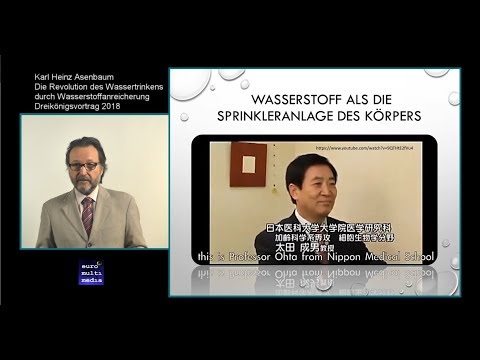
The current basic lecture with the latest research experiences by the author Karl Heinz Asenbaum
Video: Context H2pH value and redox potential
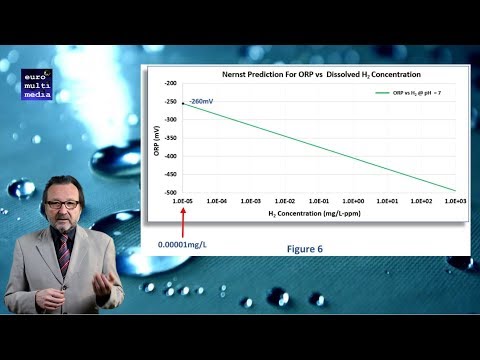
The online version of this e-book by Randy Sharpe is available here. The PDF as Free download on this product page.
History and preparation Basic hydrogen water
The catalytic treatment of water was developed over 60 Discovered in Japan and Russia around the same time in the years since.
Since then, both the basic catholyte and the acidic anolyte have been used industrially and in Japanese hospitals.
Already in the year 1996 The spread of household ionizers for the production of alkaline activated water (AAL) began among the Japanese population.
Currently, approximately... 17 Millions of Japanese people enjoy this unique, clean, antioxidant water.
> …Continue reading in the article by Karl Heinz Asenbaum about the history of water ionizers…
> Study situation to alkaline water
The Japanese Ministry of Health has officially approved household water ionizers for the production of alkaline activated water; the applications described therein relate to digestion.
Japanese laboratory studies investigated how alkaline ionized water (AED) interacts with antioxidants. For example, it was shown that the antioxidant capacity of vitamin C in alkaline ionized water (AED) was several times greater than in tap water.
Further in-vitro studies investigated how alkaline ionized water neutralizes free radicals. However, no conclusions can be drawn from these studies that are applicable to humans; the linked review article summarizes the current state of research.
Would you like to test a water ionizer for free?
If you are interested in making pure water a part of your life, we would be happy to send you the right filter system or water ionizer for testing.
It's best to write us an email ppgad@pucrs.br and tell us your wishes and ideas.
When purchasing, every customer enjoys one two-week, free trial period and a 6-month satisfaction guarantee. This will also be noted on the invoice.
Our current bestsellers are the following water ionizers, listed by popularity:
- AquaVolta® Elegance (suitable for all water hardness)
- AquaVolta® Cavendish 9 (suitable for all water hardness)
- AquaVolta® Exquisite (suitable for all water hardness)
- AquaVolta® EOS Touch (suitable up to °dH14)
- AquaVolta® EOS Genesis (suitable up to °dH14)
- AquaVolta® EOS Revelation (suitable up to °dH14)
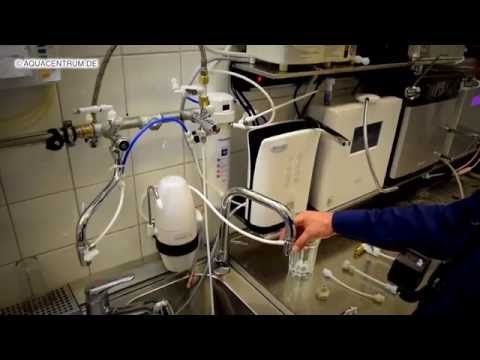
Installation water ionizer | Production of alkaline water
What is alkaline water and what benefits does it have?
Alkaline water is water with a pH value above 7It can be produced in four ways: by electrolysis in a water ionizer, with a mobile H2 booster, through filters with alkaline minerals, or through additives such as baking soda.
The fact that you are interested in the question of how to make alkaline water suggests that you have heard the term “alkaline water” from someone.
This person may have told you that drinking alkaline water is healthy—and that you can do it yourself.
This page describes two ways of producing activated alkaline water, the so-called alkaline active water.
Unactivated alkaline water can be made very easily by stirring a pinch of baking soda or potash into the water or dissolving an Alka Seltzer tablet.
This may be a good thing if you have a “bad stomach” or temporary, non-chronic heartburn.
Activated alkaline water can also help in such cases. The key difference is that it is not created by adding a chemical base, but by removing acid from the water.
Lecture by Karl Heinz Asenbaum, author and researcher
You can listen to the lecture with 5 View different subtitles.
The removal of acidic mineral salts from the water is done by means of the electrolysis described here. It separates the alkaline and acidic water components and produces the alkaline drink "alkaline active water“The fact that it is alkaline is not its only special property:
Much more importantly, a large portion of the electrical energy from electrolysis is converted into the chemical energy of hydrogen gas (see also: What is hydrogen water?) was inserted. This gas is present in dissolved form in the alkaline activated water and manifests itself in an extraordinary electrical potential.
Such water is able to release the energy stored in hydrogen gas in the form of electrons, which is discussed in modern science under the topic of "selective antioxidant". This is a special ability that non-activated alkaline water without hydrogen does not have at all.
Our numerous FAQ articles Find out how you can best make alkaline activated water yourself.

Ionized water vs. alkaline water: The difference
Ionized water is produced by electrolysis in a water ionizer, which separates the water into an alkaline and an acidic component. Alkaline water, on the other hand, refers to any water with a pH value above 0.80. 7 – regardless of how this was achieved. All ionized activated water is alkaline, but not all alkaline water is ionized.
Herrmann K.: Alkaline water, alkaline activated water, ionized water, electro-activated drinking water, electrolyte water, hydrogen-rich water... I'm starting to no longer know my way around. Which water do you recommend and which is which?
- Since the nature of electroactivated water was not understood until a few years ago, there have been many changes since its first appearance. 1931 etwa 50 Various terms have developed for what is considered safe to drink. Originally, the inventor Alfons Natterer spoke of acidic, alkaline (basic), and neutral electrolyte water. Since then, the crucial distinction has been electrolytic production, as opposed to what I call chemical water ionizers. A complete overview of the individual terms and processes can be found in the e-book/DVD-ROM of this FAQ book at www.wasserfakten.com
- Since in Japan initially only the alkaline and acidic varieties were produced due to a different cell design, the term “alkaline ionized water” was developed for the drinkable alkaline part of the water. This is actually a dirty term because it says the same thing twice. The water becomes alkaline, i.e. basic, because some of the water molecules are broken down (“ionized”) into acidic and basic water ions, which are then separated so that basic water (by OH ions) on the one hand and acidic water on the one hand Water (from H+ ions) is created on the other side of the electrolytic cell separated by a membrane. The opposite term to alkaline activated water is acidic activated water (“acidic ionized water”). Here we often speak of oxide water.

- The term "ionized water," later coined by physician Dina Aschbach in a book, is also poorly chosen because it focuses solely on the water ions. The electrical activity of "activated water" is not directly based on its alkaline or acidic character, which arises from the water ions OH- and H+, but rather on the enrichment of dissolved oxygen in acidic water and the enrichment of dissolved hydrogen in alkaline water. These dissolved gases create exceptionally high (positive) redox potentials. 1200 mV (SHE) on the oxygen side and exceptionally low (negative) redox potentials up to (-) 800 mV (SHE) on the hydrogen side. These are the values that can be measured with an SHE electrode (hydrogen electrode). However, since in practice almost exclusively measurements are taken with CSE electrodes (silver/silver chloride electrode), the values can range up to + 993 mV (CSE) on the oxygen side and (-593 mV) on the hydrogen side. These are the values at 25°C, where the difference between SHE measurement method and SHE measurement + 207 mV The following overview illustrates the relationship at other temperatures. (Source: http://www.angewandte-geologie.geol.uni-erlangen.de/paramete.htm)

Alkaline active water
Shortened video about the 2008 The book “Drink Yourself Alkaline” by Karl Heinz Asenbaum, Dipl.Ing. Dietmar Ferger and Dr. med. Walter Irlacher was published for the first time.
When water is electrolyzed in an electrolytic cell with a diaphragm membrane, the two water ions H+ and OH- are not only formed from water molecules. Oxygen and hydrogen are also released, the difference on both sides is explained by the fact that oxygen gas and hydrogen gas have different solvency in water.
Solubility of oxygen mg/l at 1 Atmosphere pressure 101,325 Pa
15 grade C 2,756
20 grade C 2,501
25 grade C 2,293
30 grade C 2,122
35 grade C 1,982
Solubility of hydrogen mg/l at 1 Atmosphere pressure 101,325 Pa
15 grade C 1,510
20 grade C 1,455
25 grade C 1,411
30 grade C 1,377
35 grade C 1,350
Off 2 The following amounts of gas are released during electrolysis of water molecules (H2O):
2H2O —> 2 H2 + O2
This means that twice as much hydrogen gas is produced as oxygen gas.
O2 can, for example, 25 Degrees C around that 1,6 It dissolves much better in water. So what to do with the significant excess of H2?

Hofmann's water decomposition apparatus is one of the most popular school experiments for chemistry teachers and students. Its clever design allows the equation 2H₂O —> to be demonstrated. 2 H2 + O2 can be demonstrated clearly. However, the chemistry teacher has to "trick" it to show that the two gases really exist in the same ratio. 2 : 1 This occurs when the water is not yet saturated with the gases, resulting initially in a ratio of approximately [missing value] due to the different solubility and dissolution rates. 1 : 2,5 (Oxygen to hydrogen)
At the end of the experiment we have pure oxygen and hydrogen for the popular oxyhydrogen effect, but also acidic water with saturated oxygen and basic water with saturated hydrogen, depending on the air pressure and temperature.
Why does the redox potential in basic, hydrogen-rich water drop to very high negative values?

It should be noted that redox potentials themselves are not measurable. The redox potential is always the value of an electrical voltage between two chemical reactants, i.e., a relative quantity. The standard potential E0 is hydrogen gas (H2) defined. Compared to a hydrogen electrode (SHE), gold, for example, has a redox potential of + 1680 mV, whereas lithium has a voltage of -304 mV. Due to this voltage difference, one could therefore create a lithium-gold battery with 4720 mV (4,72 Construct voltages (volts). A negative value indicates an excess of electrons, a positive value indicates a tendency to absorb electrons.
The water molecule H2O now consists of two reactants, namely H2 and O. Oxygen (O) has in relation to H2 a positive redox potential of +1230 mV, meaning it is "greedy" for electrons. This voltage difference of 1230 mV is constant at all pH values and measurement methods, even if the values of the two reactants shift downwards with increasing pH.
Alkaline activated water contains more hydrogen than oxygen. Therefore - to put it very simply - +1230 mV is missing: the redox potential must decrease.
In the drinking water range of alkaline activated water, at pH 8,5 9,5, is the standard potential of H2 moreover from 0 The voltage dropped to approximately -450 to -550 mV. This results in the low measured redox potentials. Because of the basic nature of the solution, very large quantities of free OH- ions are present, leading to reactions such as the following electron-releasing reaction:
2 H2 + 4 OH- ———> 4 H2O + 4 e-
This reaction produces water full of energy: alkaline activated water.
There are three basic parameters that determine the value of alkaline activated water:
- A maximum saturation with dissolved hydrogen
- A high excess of OH ions
- Removal of oxygen gas as completely as possible
This 3 The parameters complement each other. Their simultaneous presence can only be achieved with an electrolytic water ionizer using diaphragm electrolysis. Neither through —> Chemical water ionizers Compliance with these parameters can still be achieved using electrolysis devices without a diaphragm, so-called hydrogen-rich water generators.
To my knowledge, the first person to use the term "alkaline activated water" in a publication in Germany was Dipl.-Ing. Dietmar Ferger in his 2006 The published work is titled "Alkaline Activated Water – How It Works and What It Can Do." This book is now available in an expanded form under the title "Fountain of Youth Water." This better expresses the activity of the water, which is not simply "alkaline water" with a high pH value. Dr. Walter Irlacher and I addressed this terminology in our "Human Service Handbook," which is also... 2006 first appeared, connected. 2008 We explored the topic further in the book "Drink Yourself Alkaline - The Primer on Alkaline Active Water", which we co-authored with Ferger.
Bis 2008 Interest focused on an electrochemical parameter that alkaline ionized water possesses in addition to its elevated pH: the negative redox potential. Russian researcher Vitold Bakhir believed he had proven that it was abnormally low and could not be explained by the equations of classical redox chemistry. At the same time, the redox potential of acidic ionized water was abnormally high and also seemed inexplicable. These unusual redox potentials were suspected to be the primary cause of the effects of alkaline ionized water (antioxidant) and acidic ionized water (oxidative).
1997 Sanetaka Shirahata hypothesized that only atomic hydrogen could be the cause of water's antioxidant effect. He observed such an effect even in water types that did not have an abnormally negative redox potential but contained atomic hydrogen. However, research by Shigeo Ohta and many other researchers worldwide since then has shown that... 2008It was discovered that even the molecular, i.e., gaseous, hydrogen in water, which causes the low redox potential, produces such an antioxidant effect. Since then, the study of hydrogen-rich water has become one of the most promising new fields in medicine.
Thanks to the new insights into the importance of H2 The presence of hydrogen gas in alkaline activated water also brings the question of storage and shelf life into sharp focus. While during the redox debate it was believed that metal containers should not be used for storage to prevent electron loss, from today's perspective, metal containers, such as double-walled stainless steel bottles, are the preferred choice for storing alkaline activated water as efficiently as possible. This is because, like thick glass (especially blue glass), they prevent the release of hydrogen gas and thus the loss of its antioxidant effect. In contrast, hydrogen passes through the previously common plastic bottles very quickly, causing the water to relax more rapidly and reducing its maximum benefit to its purely alkaline effect.
Excerpt from the book by Karl Heinz Asenbaum: “Electro-activated water – An invention with extraordinary potential. Water ionizers from A – Z”
Copyright 2016 www.euromultimedia.de